
Is blackjack actually beatable? — Basic strategy, card counting and reality
Blackjack has the lowest house edge of any major casino game. With basic strategy you play near break-even. With card counting you can theoretically reach a positive expected value — but not in modern casinos. The honest balance sheet.
Reviewed by the Casinokeller editorial team · Editorial policy
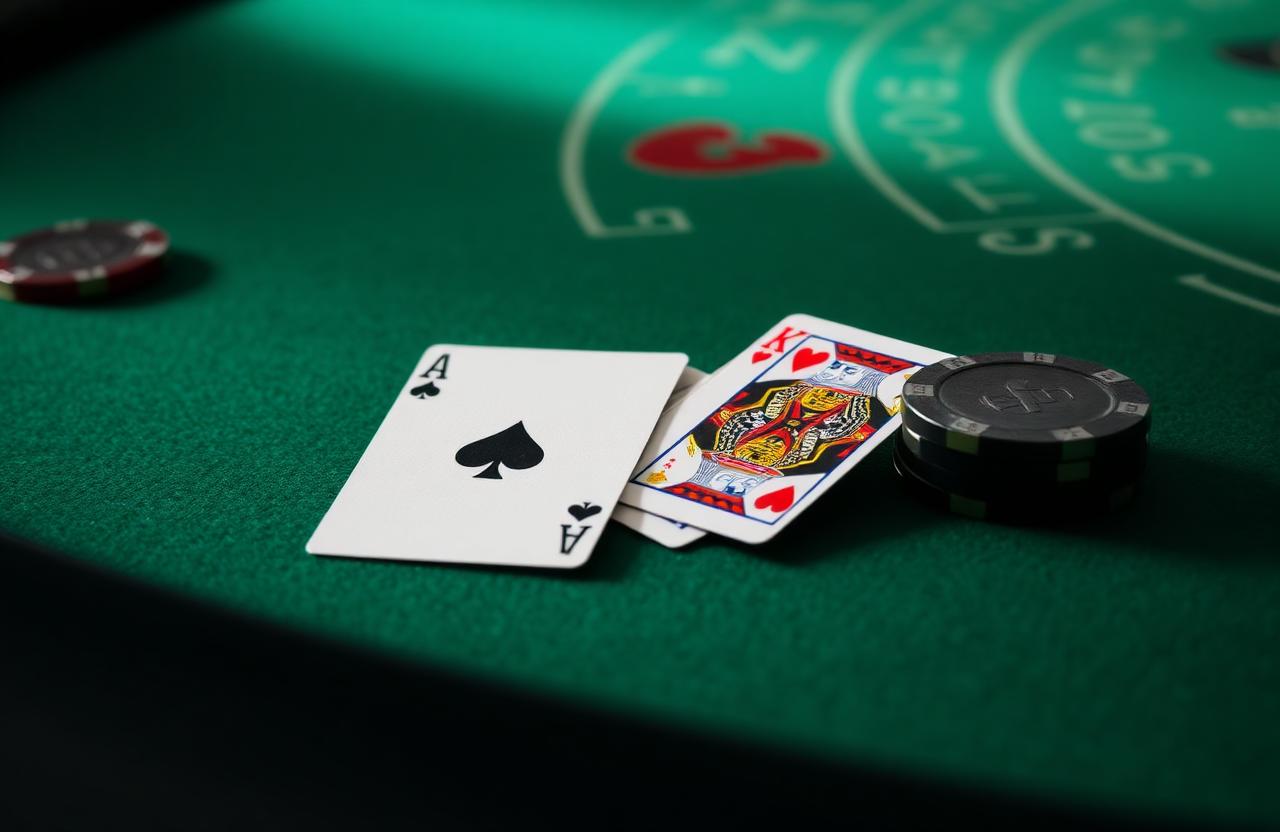
Blackjack is the only widespread casino game where player decisions substantially influence the house edge. That makes it the most mathematically interesting game in the house — and feeds a stubborn mythology that blackjack is "beatable". Let's see what's actually true.
The three tiers of blackjack: First — naive play by gut feel: house edge 2–3%. Second — perfect basic strategy: house edge 0.4–0.6% depending on rules. Third — basic strategy plus card counting: theoretical player edge 0.5–1.5%. Each tier is a different world.
Basic strategy: The mathematically optimal decision for every hand-dealer combination. Known since the 1960s, fully published, learnable in 5 hours. Consistent application reduces house edge under good rules (3:2 payouts, dealer stands on Soft 17, double after split allowed) to about 0.4%.
Example: 25 € stake, 80 hands/hour, 0.5% house edge → 10 €/hour expected loss. Compare: a slot at 4% house edge and 1 €/spin × 600 = 24 €/hour. Among major games, blackjack with basic strategy offers the best price/entertainment ratio.
Card counting: the misunderstood concept: Cards aren't "memorised" — they're weighted. In Hi-Lo, low cards (2–6) get +1, high cards (10, J, Q, K, A) get −1, middles 0. The running count divided by remaining decks gives the "true count". On positive count the player raises stakes because more high cards = more blackjacks for the player and more bust risk for the dealer.
Theory vs reality: Theoretical card-counting edge: 0.5–1.5%. Sounds like an ATM. In practice: first, modern casinos use 6–8 decks with the cut card at 75% — true count rarely gets high enough. Second, trained pit bosses spot variable-stake players within 30–60 minutes. Third, online live casinos use automatic shuffle machines — counting is mathematically impossible.
What happens if you're caught? Casinos in most jurisdictions have house rights. You won't be arrested (counting isn't illegal) but you'll be asked to leave or "backed off" — allowed to play anything except blackjack. Vegas has an unofficial list shared between casinos.
Bankroll reality: Even a player with 1% edge needs a bankroll of 500–1,000 max bets to survive variance. At 100 € max bet that's 50,000–100,000 € starting capital. Pro counters in the 70s and 80s played in teams (see MIT Blackjack Team). Today conditions are so poor that even teams barely turn a profit.
What about online blackjack? RNG-based online blackjack shuffles after every hand — counting is mathematically useless. Live-dealer blackjack with real cards would theoretically allow it, but speed (40 hands/hour) and cut-card position make the edge too small for real profit after variance and licensing constraints.
What's left for the normal player? Basic strategy. It's legal, allowed at every table, learnable in 5 hours and reduces hourly loss by a factor of 4–6. That's real, measurable and risk-free. Counting isn't worth it for 99.9% of players — basic strategy is.
What you can realistically expect: With basic strategy and 25 € stake: ~10 €/hour expected loss, ±150 € session standard deviation. Across 50 two-hour sessions per year: expected total loss 1,000 €, with high probability somewhere between +500 € and −2,500 €. That's the "best deal" in the house — not an ATM.
Tools on Casinokeller: House-edge calculator for blackjack variants and bankroll simulator for realistic distributions. Both ad-free, no affiliate links.
Bottom line: Blackjack is the fairest casino game — but "fair" means 0.5% house edge, not "beatable". Learn basic strategy. Forget card counting except as a historical hobby. And treat blackjack as what it is: an inexpensive form of casino entertainment with a mathematically transparent price.