Blackjack Insurance — Is the Side Bet Actually Worth It?
When the dealer shows an ace, the casino offers you insurance. Sounds safe — but is one of the most expensive side bets in the building. We work out exactly why insurance is never +EV (except for card counters).
Reviewed by the Casinokeller editorial team · Editorial policy
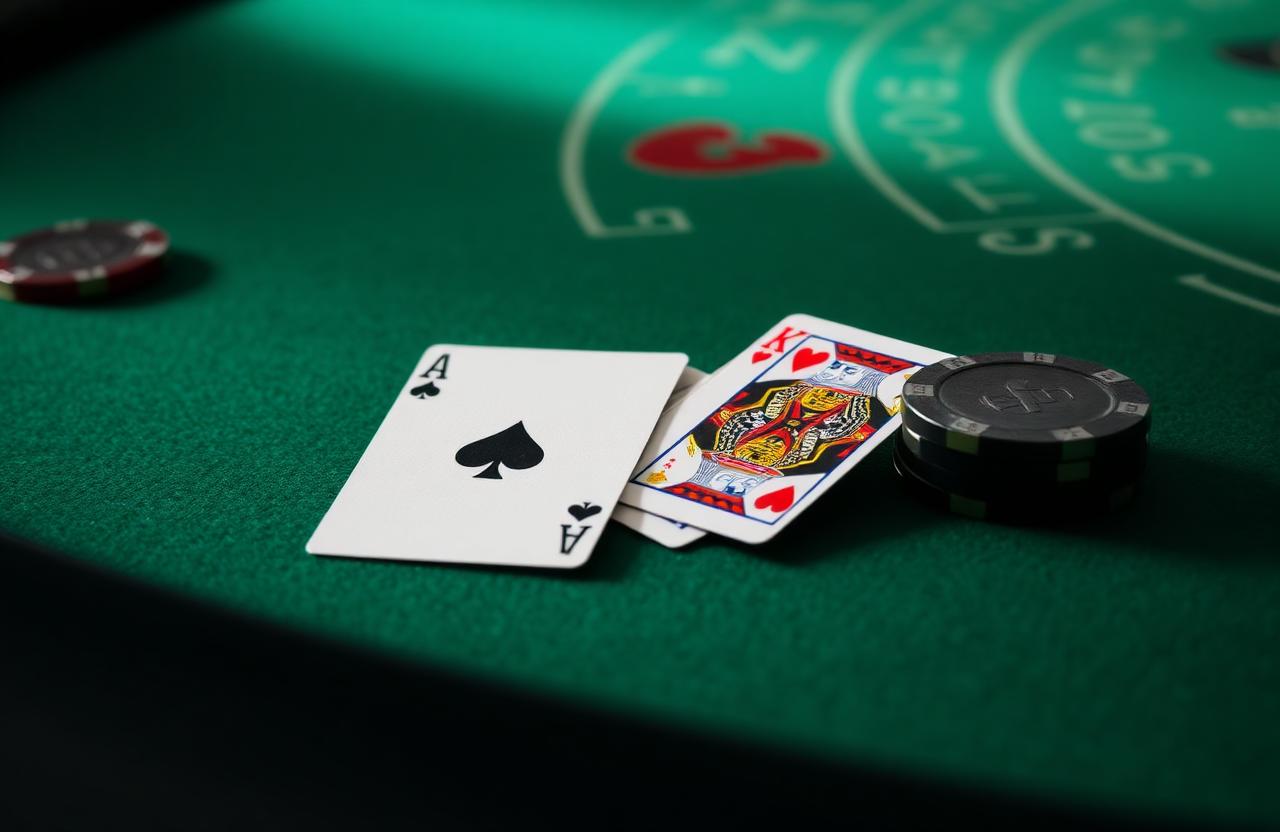
Blackjack insurance is the side bet every dealer offers you once their upcard is an ace. You can wager up to half your main stake as 'insurance' — if the dealer has a blackjack (hole card = 10), it pays 2:1. If not, the insurance loses and the main hand plays normally.
How the casino frames it: 'Protect yourself against a dealer blackjack — never walk away empty-handed.' Sounds sensible, almost friendly. Mathematically it is one of the worst bets in the whole casino.
The numbers: From a fresh deck, 16 of the remaining 49 cards are 10-value (10, J, Q, K). Probability of a dealer blackjack = 16/49 ≈ 32.65%. Probability of NO blackjack = 67.35%.
Expected value per €1 of insurance: Win €2 × 0.3265 − Lose €1 × 0.6735 = 0.653 − 0.6735 = −€0.02. That works out to about a 7.4% house edge on the insurance bet. For comparison: European roulette 2.7%, German online slots 4%. Insurance is more expensive than virtually any main bet on the floor.
On multi-deck shoes the effect shrinks slightly (about 5.9% house edge on 8 decks) but stays clearly negative. In no standard variant is insurance a correct bet.
The psychological trick: The casino only offers insurance when you happen to hold a nice hand (otherwise you wouldn't think about risk at all). You focus on 'what happens if the dealer has blackjack?' — not on the expected value across all cases. Classic framing.
The 'even money' special case: When you have a blackjack yourself and the dealer shows an ace, the casino often offers an immediate 1:1 payout instead of the usual 3:2. Mathematically identical to a full insurance bet. EV is negative — you give up about €0.07 per €1 of bet. Same advice: refuse, play it out.
The only exception — card counting: If you know the shoe is rich in 10s (Hi-Lo true count ≥ +3), the math flips. At a sufficiently positive count, insurance is +EV. But: without active counting you don't have that information — you're guessing. Guessing is −7.4%.
What insurance costs on average: A player who insures 50% of their stake on every insurance offer (i.e. the default reflex) gives up 0.4–0.5% of house edge long-term. A correct-basic-strategy table sits at 0.5% edge — adding insurance pushes it to 0.9–1.0%. You roughly double your long-term loss with one wrong decision in 8% of hands.
Rule of thumb: Insurance is NEVER part of basic strategy. When the dealer shows an ace, decline and play your hand. Same with your own blackjack — don't take 'even money', wait it out and bank 3:2 whenever the dealer doesn't have blackjack. You lose the full bet now and then — but on average you collect 3:2 more than twice as often as 0.
Why does the casino offer it? Because it is profitable — for them. Insurance is estimated to generate 0.3–0.5% of all blackjack revenue. A mid-sized casino with €50m of annual blackjack drop sees €150,000–250,000 of pure insurance loss from players.
Related: 'Blackjack basic strategy — the complete chart', 'Does card counting still work?' (why the exception doesn't matter online), 'Blackjack house edge with basic strategy'. Tool: house-edge calculator — compare the 0.5% vs. 1.0% table over your planned session length.
Bottom line: Blackjack insurance is a disguised side bet with a 7.4% house edge. It has nothing to do with 'protection' — it is a separate bet on the dealer's hole card that you take with inadequate information. The correct answer to the insurance offer is always 'no' — no matter how good your hand looks.